




Murata Noise Suppression for Wireless Headphones
As the popularity of wireless headsets keeps growing, so does the use of BLUETOOTH®. The wireless technology standard is often used for communication between smartphones and headsets. However, audio can skip due to communication errors, so countermeasures are required. Murata examines this difficult issue, depicting an actual case to explain the interference mechanism in the device, which causes the audio to skip. Murata researched useful countermeasures to solve the issue.
Design Problems/Span
Murata believes there are primarily two types of design problems.
• Interference within the headphone device, which absolutely requires a way to resolve the problem of audio skipping
• Mounting area restrictions in headphones (Figure 1, below), including true wireless headphones with separate left and right sides
The first design problem -- interference within the headphone device -- is extremely important here.
Figure 1

Verification of countermeasures
In many cases of internal headphone interference, unwanted radio waves within the device are superimposed on top of the signals required for communication. This creates noise and causes the audio to skip.
Murata used commercial products to measure the minimum reception level of a 2.4GHz signal. It wanted to verify differences in the likelihood of audio skipping caused by design countermeasures to prevent interference within Bluetooth devices.
In terms of internal device interference, large graph values indicate communication is possible even with a weak signal and the audio is unlikely to skip. Murata confirmed various levels depending on the product but wanted to know why they were so different.
Murata verified the reason why such differences occur using Product A, where audio skipping was frequently observed, and Product D, where the issue was infrequent.
Figure 2

Audio skipping measurement
In order to know the differences between the minimum reception levels of Product A and Product D, Murata observed the noise spectrum received by the antenna. Signals flow through a Bluetooth antenna to communicate, but communication failures occur if noise gets into the signal flow.
The left side of Figure 3 (below) shows Product D, which has good reception sensitivity, while the right side shows Product A, which has poor sensitivity.
The red areas on the graph show the noise level when the power supply is turned off, and the blue areas show the noise level during pairing.
Bluetooth utilizes frequency hopping, so communication signals appear as a narrowband spectrum. Due to high sensitivity, the communication signals were verified on Product D only, and no other spectrum appeared.
In contrast, a spectrum with a frequency band of several MHz was confirmed on Product A with its poor sensitivity (red marks).
Because Bluetooth uses frequency hopping, when this type of noise spectrum occurs across all communication frequency bands, noise mixes with the communication signal and degrades the sensitivity.
Figure 3

Product comparison of audio skipping measurement results
To investigate the cause of the wideband noise shown by the red marks, Murata measured the magnetic field distribution on the board surface of Product D (Figure 4, below).
Because the noise source differs in actual noise suppression, depending on the setting and situation, it is important to identify the circuit location for effective noise reduction in advance.
The right side of Figure 4 shows the results for the magnetic field distribution strength when the frequency is fixed to 2.4GHz. The red area represents a strong magnetic field. This indicates the Bluetooth RFIC, with a particularly high magnetic field strength in the DC-DC converter circuit area, would be an effective location for noise suppression.
This noise is switching noise, which occurs when generating power internally. Murata assumed the higher harmonics of the switching frequencies were occurring in the 2.4GHz band.
Figure 4
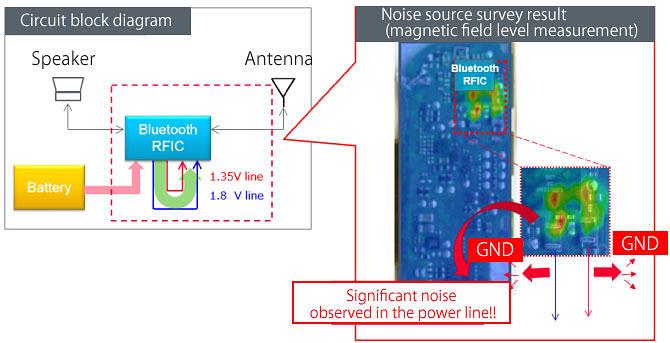
Measurement of the magnetic field distribution in the board surface of Product D
Murata investigated countermeasures to deal with the audio issue.
Figure 5 (below) shows the measurement environment used to take measurements and the result of measuring noise coupled with the Bluetooth antenna.
An extremely high level of noise was observed, which requires noise suppression to reduce the level.
Figure 5

Measurement result for noise coupled with a Bluetooth antenna
When implementing Bluetooth noise suppression, Murata determined there are two key implementation areas.
The first area is the power supply line, and the second is the clock line.
Because the power supply line generates higher harmonics due to switching, and the higher harmonics of the clock signal extends into the 2.4GHz band, noise is created in the Bluetooth signal. Filtering is an effective way to suppress noise conduction.
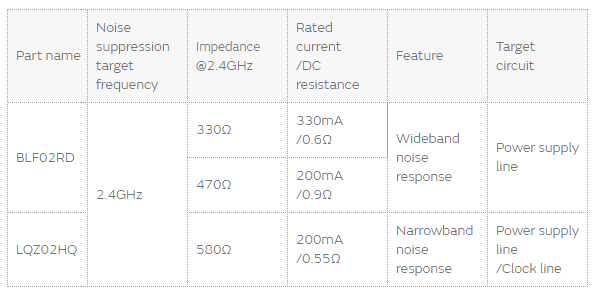
Murata has commercialized two types of filters that are designed to remove noise in the 2.4GHz band.
The first type includes the BLF02RD and LQZ02HQ filters for power supply lines, while the second type consists of the LQZ02HQ series for clock lines.
Table 1 and Figure 6 (both below) show the representative electrical specifications and insertion loss frequency characteristics of the BLF02RD and LQZ02HQ filters used for noise suppression in this instance.
In many cases, the power supply line and clock line are major sources of noise, and using the appropriate filter in those circuit areas is an effective solution.
Table 1
Electrical specifications
Figure 6
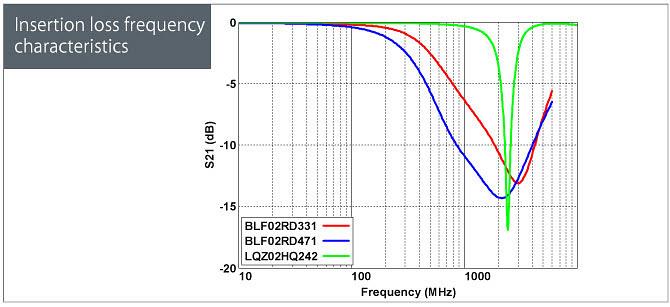
Insertion loss frequency characteristics
Measurement Results (Antenna Coupled Noise)
These are the results of measuring the noise spectrum coupled with the antenna during Bluetooth communication.
The BLF02RD filter was inserted into the power supply line (Figure 7, below). By doing so, Murata was able to improve the narrowband noise by about 5dB. This verified the BLF02RD filter is an effective solution.
Figure 7

Power supply line: BLF02RD measurement result
In a similar fashion, the LQZ02HQ filter was inserted into the power supply line (Figure 8, below). Murata verified a similar level of improvement in the narrowband noise by approximately 5dB.
Figure 8

Power supply line: LQZ02HQ measurement result
To continue, Murata inserted the LQZ02HQ filter into the clock line and observed the waveform and noise spectrum (Figure 9, below).
Because the LQZ02HQ filter has few low-frequency attenuation characteristics, it removes only the problematic spectrum in the 2.4GHz band while maintaining the signal quality.
Murata concluded it is an effective way to suppress noise in a signal line such as a clock.
Figure 9
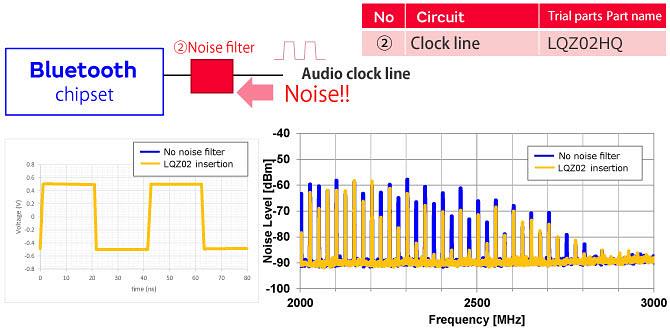
Clock line: LQZ02HZ measurement result
Summary
In this case, inserting a noise filter into the DC-DC converter circuit was effective, but the noise source may differ in some cases. The verification method explored in the previous example is just one example, but identifying a noise source is vital in dealing with noise suppression.
Murata recommends the BLF02RD/LQZ02HQ series of noise filters for use in different circuit areas. Both series are suitable for power supply lines, and the LQZ02HQ series is also ideal for clock lines. The BLF02RD/LQZ02HQ series feature significant attenuation in the 2.4GHz high frequency range and can be expected to provide significant noise attenuation.
In this case, Murata introduced an example of noise suppression where noise within the same circuit interfered with the Bluetooth communication signal. This technology can also be applied in non-Bluetooth devices that communicate at a frequency of 2.4GHz. Murata implemented noise suppression components that are highly effective in the high-frequency range of 2.4GHz and come in an ultra-miniature size of 0.4mm x 0.2mm to conserve space. Murata recommends its components to prevent audio skipping on a miniature scale.
SimSurfing Tool

Community Forum
Murata Community Forum provides searchable content with various discussion topics, popular blogs, and articles. The Murata broad market support team holds regular reviews to discuss open issues, allowing inquiries to be answered in a timely manner. The forum content is freely accessible to the public. However, users must log in to post questions or answers. Registration is free of charge.
Learn More

Murata EMI雜訊抑制
為工程師提供完整的支援,包括產品 & 設計模擬軟件解決方案。
Related Products

Murata Electronics BLF Chip Ferrite Beads
Range of models that are ideal for general purpose to powertrain and safety applications.
Murata LQZ陷波濾波器
345至600Ω電阻範圍、13至15.7dB額定插入損耗及200mA額定電流。